Top Luxury Safari Accommodation Options: 2026 Definitive Guide
In the competitive landscape of high-end global travel, the term “luxury” is frequently deployed as a catch-all, yet in the context of the African wilderness, it undergoes a profound specialization. For the discerning traveler, the quality of a stay is no longer measured solely by the presence of a thread-count or a private chef, but by the integrity of the wilderness access provided. The modern expeditionary architecture of 2026 has transitioned from the “resort-style” imitations of European hotels to a more nuanced, site-specific philosophy that prioritizes environmental immersion and operational exclusivity.
Selecting the right environment requires a departure from traditional hospitality metrics. A property may offer gold-plated fixtures and Michelin-starred dining, but if it sits within a congested national park where twenty vehicles crowd a single leopard sighting, the “luxury” of the experience is fundamentally compromised. The true gold standard in 2026 is exclusivity of land, where a lodge controls its own private concession, allowing for off-road traversal, night drives, and—most crucially—the luxury of silence.
This article provides a definitive, systemic analysis of the current landscape. We will move beyond the surface-level “best-of” lists to examine the structural frameworks that define a premier stay. From the engineering of “light-footprint” mobile camps to the administrative governance of ultra-exclusive private villas, this is a deep-dive reference for those who view a safari not as a vacation, but as a strategic engagement with one of the planet’s final frontiers.
Top luxury safari accommodation options
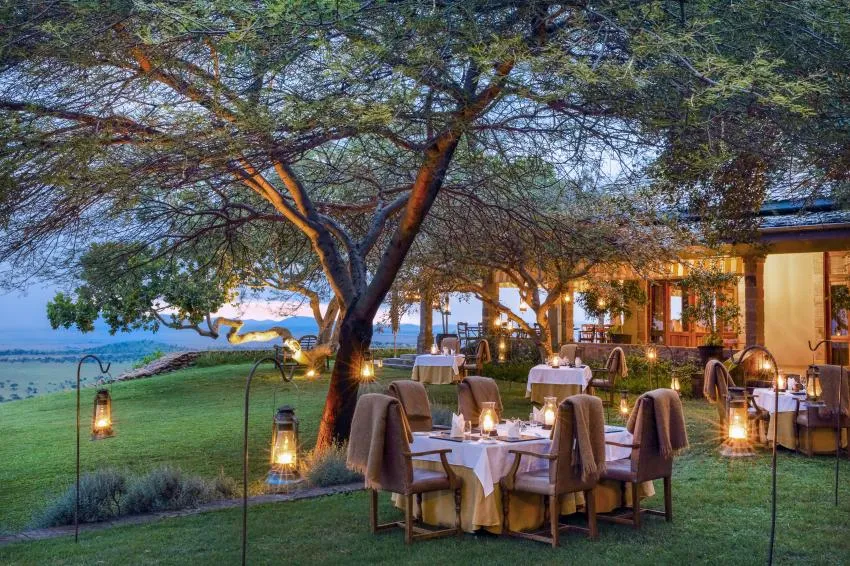
To effectively analyze top luxury safari accommodation options, one must categorize properties based on their “Operating Philosophy.” In the 2026 market, these are generally segmented into three dominant models: The Heritage Conservancies (e.g., Singita, Wilderness), The Ultra-Exclusive Private Houses (e.g., Royal Malewane, AIE), and The Boutique Expeditionary Camps (e.g., Jack’s Camp, San Camp).
The Heritage Conservancies are the architects of the modern “low-volume, high-value” model. Properties like Singita Lebombo in South Africa or Mombo Camp in Botswana do not merely provide a bed; they provide a stake in a massive, privately managed ecosystem. Here, the luxury lies in the Guide-to-Hectare ratio. When a lodge limits its guest count to 20 people across 33,000 acres, the service becomes a byproduct of the space itself. Every game drive is a private encounter because the land-to-guest density is mathematically optimized for solitude.
A common misunderstanding is that “Safari Hotels” (larger, permanent structures often found near park gates) belong in the same conversation as true luxury lodges. While brands like the Four Seasons Serengeti offer impeccable resort-level amenities, they operate within public national parks. This introduces a “Public Access Friction” where your luxury room is world-class, but your game-viewing experience is subject to the traffic and regulations of a government-run park. To compare top luxury safari accommodation options accurately, the traveler must decide if their priority is the internal environment (the room) or the external environment (the bush).
The rise of the “Private House” or “Villa” model represents the apex of the current market. Designed for multi-generational families or high-net-worth individuals, these properties—such as The Farmstead at Royal Malewane or Chongwe House—offer “Single-Key Exclusivity.” This means the entire staff, from the master tracker to the executive chef, is dedicated to a single party. This level of autonomy allows for a “Dynamic Itinerary,” where the day’s rhythm is not dictated by lodge schedules but by the movement of the animals and the whim of the guest.
The Historical Trajectory: From Canvas to Conservation-Luxe
The evolution of safari accommodation is a mirror of changing human values regarding the natural world. In the early 1900s, “luxury” was a logistical feat of portage—European explorers and hunters recreating Edwardian dining rooms in the middle of the Serengeti using hundreds of porters. This was the era of Functional Opulence, where the goal was to insulate the traveler from a “hostile” environment.
By the 1970s and 80s, the model shifted toward Permanent Structures. Solid walls and thatched roofs replaced the mobile canvas, allowing for the first iteration of “bush-chic” interior design. However, this era often ignored ecological impact, leading to “Heavy Footprint” lodges that were difficult to remove and environmentally taxing to maintain.
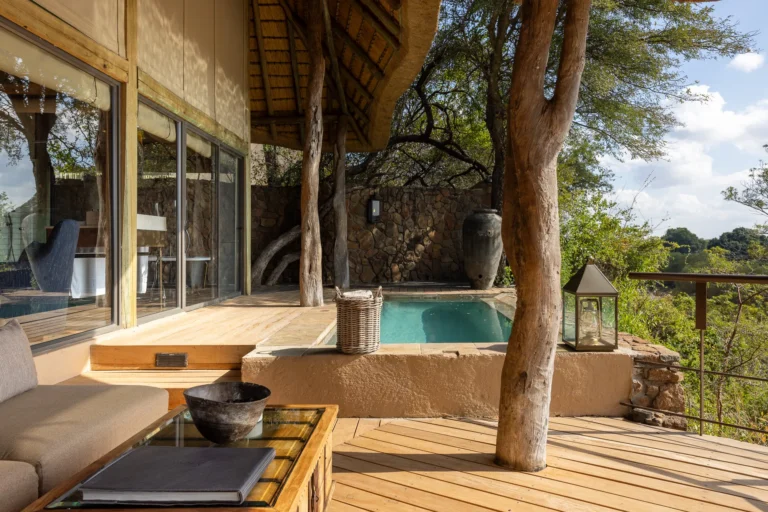
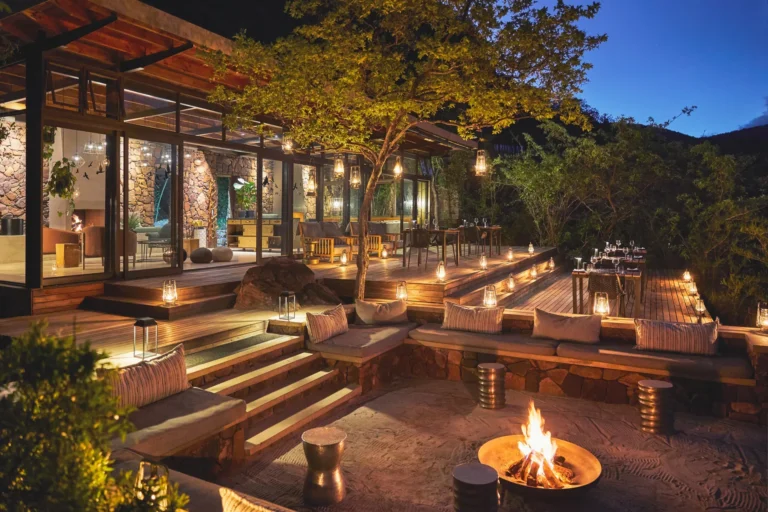
In 2026, we have entered the age of Biophilic Design. Leading architects now use sustainable timber, local stone, and high-tension canvas to create structures that are “removable.” If the lodge were to be decommissioned tomorrow, the land would return to its natural state within a year. This “Light-Touch” philosophy is now a mandatory requirement for any property claiming to be among the top luxury safari accommodation options.
Conceptual Frameworks for Evaluating Luxury Tiers
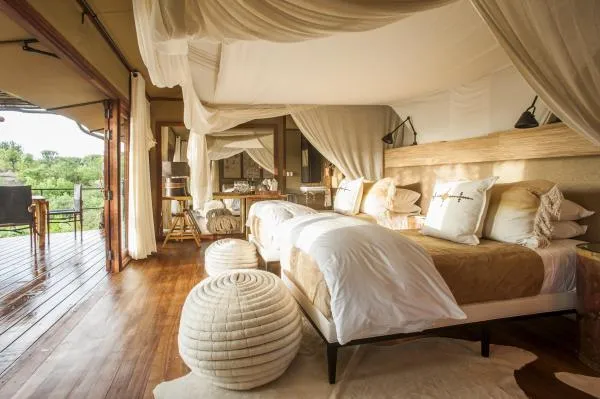
When auditing a property, professional travel editors use these three mental models:
The “Acoustic Luxury” Framework
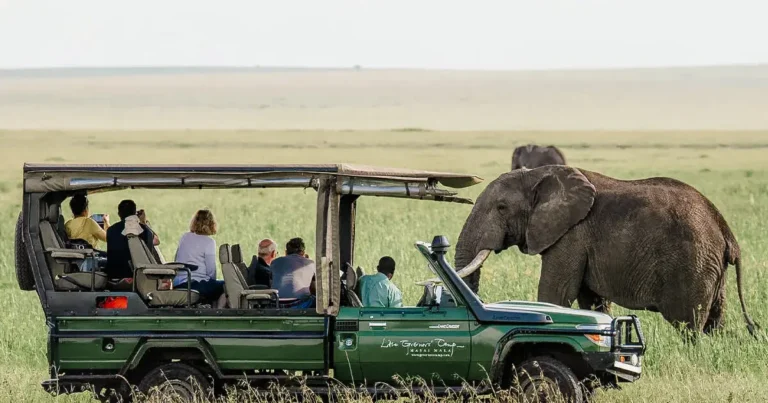
True luxury in the bush is the absence of mechanical noise. Properties that utilize Electric Safari Vehicles (EVs) or prioritize “silent” solar power over diesel generators rank higher. The ability to hear the footfalls of an elephant without the thrum of a combustion engine is a premium service that cannot be bought with mere decor.
The “Inventory of Access” Model
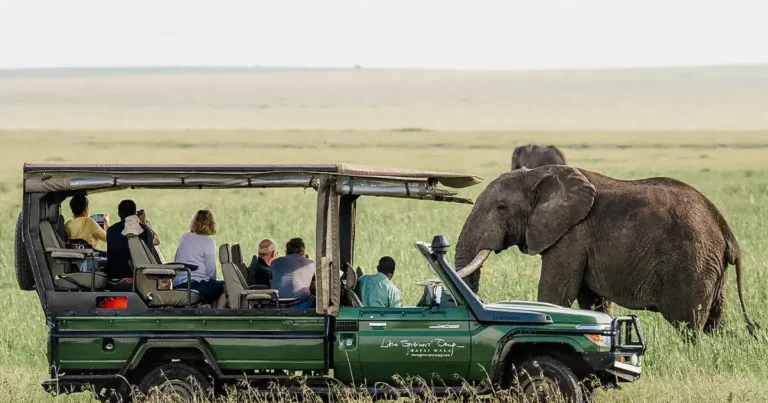
This framework evaluates the lodge based on its Off-Road Rights. In the Sabi Sands or the Okavango Delta, private concessions allow vehicles to leave the road to follow a leopard into the brush. In public parks, you are legally tethered to the gravel. The “Access” model dictates that a $1,000 tent in a private concession is more “luxurious” than a $2,000 suite in a public park.
The “Institutional Memory” Framework
A lodge is only as good as its staff’s tenure. Top-tier properties (like those in the Londolozi portfolio) often have trackers and guides who have worked the same land for thirty years. Their “biological intelligence”—knowing which leopard cub belongs to which mother—is an invisible luxury that enhances every sighting.
Key Categories of Luxury Accommodations and Trade-offs
| Category | Primary Focus | Best For | Technical Trade-off |
| Private Concession Lodge | Exclusivity & Land Rights. | Serious wildlife enthusiasts. | Often requires bush flights to reach. |
| Ultra-Luxury Villa | Privacy & Staff Dedication. | Multi-gen families; UHNWIs. | Highest cost; less “social” interaction. |
| Luxury Mobile Camp | Location & Migration Following. | Adventurous purists. | No permanent plumbing; bucket showers. |
| Resort-Safari Hotel | Familiarity & Stability. | First-timers; families with elders. | Higher guest density; public park access. |
| Treehouse / Star Bed | Immersion & Romance. | Honeymooners; short stays. | Exposure to elements; minimal amenities. |
Decision Logic for 2026
If your goal is the Great Migration, a high-end mobile camp like Singita Explore is superior because it moves with the herds. However, if your goal is Predator Tracking, the stationary lodges of the Sabi Sands are unbeatable due to the high density of habituated big cats that stay in fixed territories.
Operational Scenarios: The Mechanics of a Stay
Scenario A: The Private House Advantage
A family of eight books an exclusive-use villa in the Mara North Conservancy.
-
The Constraint: Young children (under 6) are often barred from shared game drives in standard lodges.
-
The Solution: In a private house, the children have their own vehicle and a “junior ranger” program. The parents can go on a six-hour track while the children do a “bug safari” near the villa.
-
Second-Order Effect: The family avoids the social friction of disturbing other guests, creating a more relaxed environment for everyone.
Scenario B: The Mobile Migration Strategy
A photographer books a luxury mobile camp in the Northern Serengeti.
-
The Strategy: The camp is situated 10 minutes from a major Mara River crossing.
-
The Failure Mode: Stationary lodges might be a 2-hour drive from the action if the herds move unexpectedly. The mobile camp “re-pitches” its location based on live satellite data of the migration.
Planning, Cost, and Resource Dynamics
The financial structure of top luxury safari accommodation options is “All-Inclusive,” but the definition of “All” varies significantly between tiers.
| Resource | Mid-Tier Luxury ($800/night) | Ultra-Luxury ($2,000+/night) |
| Land Type | Shared / Public | Private / Exclusive |
| Guide Level | Generalist | Specialist / Master Tracker |
| In-Room Amenities | Minibar, standard AC | Private pool, Starlink, Butler |
| Logistics | Group transfers | Private bush flights included |
The Risk Landscape: Failure Modes in High-End Safari
Even at the $3,000-per-night level, systemic risks exist:
-
The “Resort” Trap: A lodge focuses so much on the spa and dining that the guiding quality suffers.
-
The “Habituation” Risk: In over-touristed areas, animals become “car-blind,” behaving unnaturally or ignoring vehicles, which robs the experience of its wild “edge.”
-
The “Logistical Chain” Break: Relying on regional airlines can lead to “Luggage Lag.” Top lodges mitigate this by providing high-quality rental gear (cameras/binoculars) on-site.
Governance and Sustainability: The Ethical Mandate
In 2026, a property cannot be considered “top tier” without a transparent Conservation Governance model. Travelers should look for:
-
Land Lease Transparency: Does the lodge pay fair market value to the local Maasai or San communities?
-
Energy Sovereignty: Is the lodge 100% solar or hydrogen-powered?
-
Waste Circularity: Properties like &Beyond Phinda have “plastic-free” supply chains and onsite water bottling plants.
Measurement and Evaluation: The “Post-Stay Audit”
How do you know if your stay was worth the investment?
-
Qualitative Signal: Did the guide narrate the ecology of the bush, or just point out the animals?
-
Quantitative Indicator: The “Solo Sighting” count. Out of 10 major sightings, how many did you have to share with more than one other vehicle?
-
Documentation Example: A “Wildlife Ledger” provided by the lodge at the end of the stay, detailing every species seen and the conservation status of the land you traversed.
Common Misconceptions and Industry Fallacies
-
Myth: “The most expensive lodge has the most animals.”
-
Correction: Animals move. Exclusivity of access is more important than price.
-
Myth: “A tented camp is less safe than a stone lodge.”
-
Correction: In the luxury tier, tents are high-security environments with 24/7 “askari” (guards) to escort guests.
-
Myth: “You need to stay in 5 different lodges to ‘see’ Africa.”
-
Correction: “Safari Fatigue” is real. The best value is found in staying 4 nights at one high-end property rather than 2 nights at two different ones.
Conclusion: The Future of Wilderness Sovereignty
The landscape of top luxury safari accommodation options in 2026 is moving toward a model of “Wilderness Sovereignty.” The most successful properties are those that act as protectors of the land first and hoteliers second. For the traveler, the choice of accommodation is a vote for a specific conservation philosophy. By choosing properties that prioritize private land rights, low-impact architecture, and veteran guiding, the traveler ensures that their presence in the bush is not just a luxury but a vital contribution to the survival of the African wild.