The Definitive Guide to Professional Luxury Safari Guiding & Standards
In the competitive landscape of high-end travel, the distinction between a standard tour and a world-class expedition often rests on a single variable: the presence of an elite practitioner. The role of a luxury safari guide transcends the basic functions of navigation and wildlife spotting. These individuals serve as the intellectual and logistical linchpins of the journey, acting as master storytellers, field biologists, and crisis managers in some of the planet’s most unforgiving environments.
To the untrained eye, a guide is simply the person behind the wheel of a 4×4. However, in the luxury tier—where travelers invest tens of thousands of dollars for a single week—the expectations for a guide are as rigorous as those for a specialist surgeon or a high-stakes diplomat. They are expected to interpret the subtle linguistics of the bush, anticipate animal behavior before it manifests, and manage the psychological comfort of their guests with an invisible hand.
This article serves as a definitive exploration of the modern professional guiding landscape. We will move beyond the superficial “Big Five” checklists to analyze the systemic evolution of the profession, the technical frameworks of field interpretation, and the risk-management protocols that define the absolute peak of the industry. This is a study of a vocation that requires equal parts physical grit and intellectual sophistication.
Understanding “Luxury safari guide.”
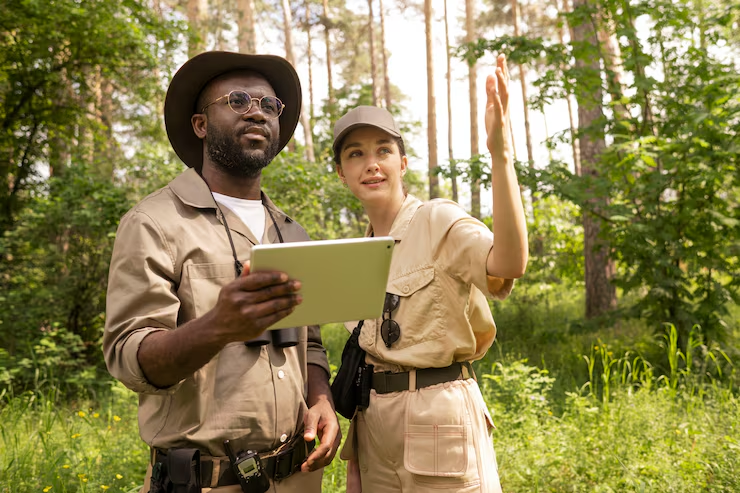
The term luxury safari guide is frequently misused in travel marketing to describe any guide employed by a five-star lodge. This is an oversimplification that risks undermining the true professional standard. A genuine luxury guide is defined not by the brand on their uniform, but by a specific set of qualifications and a level of “soft-skill” mastery that allows them to customize an experience in real-time.
A primary misunderstanding is the belief that “luxury” correlates with “catering to every whim.” In a professional field context, a luxury guide must often exercise authority over the guest to ensure safety or ecological integrity. The luxury lies in the unfiltered access the guide provides through their knowledge—turning a silent landscape into a readable “newspaper” of tracks, calls, and scents.
Furthermore, the “private guide” model is the ultimate expression of this niche. While lodge-based guides are tied to a specific property, a private luxury safari guide accompanies a guest across multiple countries and ecosystems. This requires a continental breadth of knowledge—understanding the differences between the granitic sands of the Sabi Sands and the alluvial floodplains of the Okavango. The failure to distinguish between a “site guide” and an “expedition leader” is a significant risk for travelers seeking a truly cohesive journey.
The Evolutionary Path of Safari Guiding
The modern safari guide is the result of a century-long shift from colonial extraction to scientific conservation. In the early 20th century, the “White Hunter” archetype was the industry standard. These individuals were valued for their ability to manage largeporter’ trains and ensure the safety of hunters. The “luxury” of that era was purely material: silver service in the middle of a desert.
As hunting was increasingly restricted or banned in favor of photographic tourism (starting in the mid-1930s in Kenya and expanding post-WWII), the guide’s role shifted toward interpretation. The rifle, once a primary tool of the trade, became a secondary tool of last resort, primarily used by “Trails Guides” on walking safaris.
Today, the elite guide is a “Conservation Ambassador.” They are often highly educated—many holding degrees in zoology or environmental science—and are expected to engage guests in complex discussions about carbon sequestration, human-wildlife conflict, and the genetics of isolated populations. The “luxury” has migrated from the dinner table to the intellectual content of the drive itself.
Conceptual Frameworks and Interpretive Models
To achieve the level of a luxury safari guide, one must operate through several mental models that ensure a high-quality guest experience regardless of wildlife visibility.
The “Acoustic Horizon” Model
This framework involves the guide’s ability to map the environment through sound. A professional guide doesn’t just hear a bird; they hear an “alarm call” and can triangulate the location of a predator based on the intensity and direction of that sound. This allows them to predict where a leopard will emerge minutes before it appears.
The “Ecological Connectivity” Framework
Luxury guiding is about moving from “What is that?” to “Why is it here?” A guide using this model explains the relationship between the soil (geology), the grass (botany), and the herbivore (zoology).
-
Limit: This can become too academic if not balanced with storytelling. The guide must know when to stop lecturing and allow the silence of the bush to take over.
The “Anticipatory Hospitality” Loop
In the field, this means predicting a guest’s needs before they are voiced—whether it’s a specific camera angle, a fleece jacket for a sudden temperature drop, or a change in the itinerary based on the guest’s fatigue levels.
Categories of Specialized Guiding and Trade-offs
Not all top-tier guides possess the same skill sets. When selecting a leader for an expedition, it is critical to understand these variations.
| Category | Primary Focus | Key Certification (Example) | Trade-off |
| Trails Guide | Walking safaris & dangerous game | FGASA Apprentice Trails / Lead Trails | High physical demand; less focus on vehicle comfort |
| Specialist Birding Guide | Avian biodiversity & endemics | Advanced Birding Modules | May overlook charismatic megafauna for rare warblers |
| Private Expedition Leader | Multi-country logistics & hosting | 10+ years experience; private license | High cost; requires early booking (12–18 months) |
| Photographic Guide | Lighting, positioning, & post-processing | Technical Portfolio | May spend hours at one sighting for the “perfect shot.” |
| Cultural Liaison | Indigenous history & community engagement | Local Community Certification | Often limited to specific geographical regions |
Realistic Decision Logic
A photographer should prioritize a guide who understands “vehicle positioning” (keeping the sun at the photographer’s back), whereas a family with children might prioritize a guide with high “edutainment” skills who can keep young minds engaged with tracking and small-scale biology (insects and plants).
Logistical Scenarios and Field Decision Points
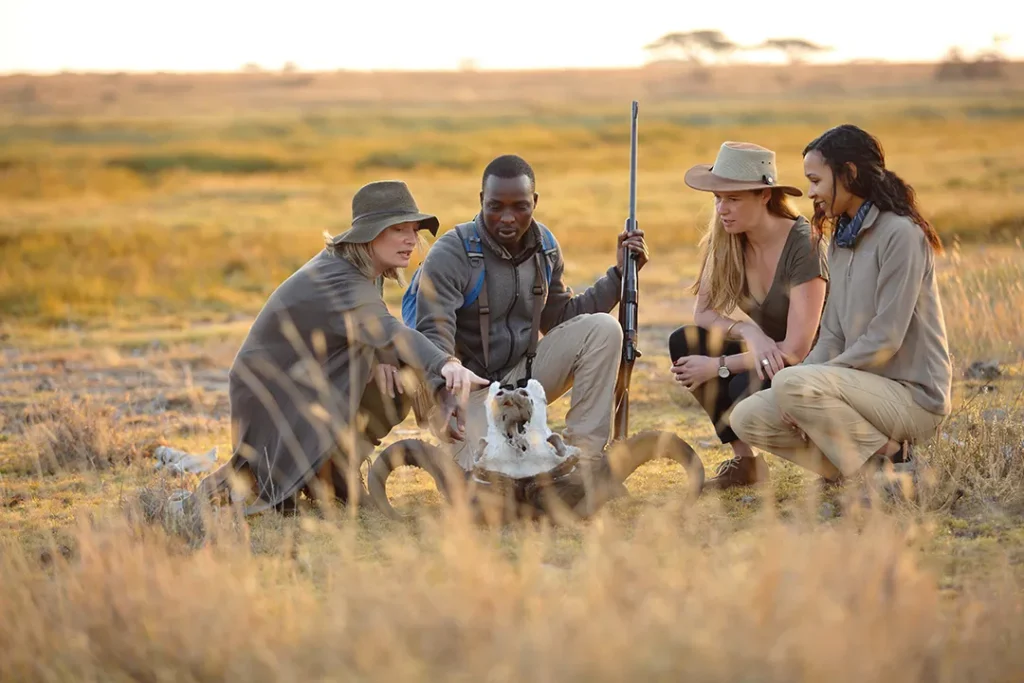
The quality of a luxury safari guide is most evident when things do not go according to plan.
Scenario A: The “Vanishing” Leopard
In a high-pressure situation where guests have waited days to see a leopard, the guide finds a fresh track that leads into thick wait-a-bit thorn scrub.
-
Decision Point: Does the guide push the vehicle into sensitive habitat (risking ecological damage and a stuck vehicle) or manage guest expectations by explaining the “hide-and-seek” ecology of the cat?
-
Failure Mode: A low-tier guide might harass the animal to please the guest. A luxury guide uses the moment to teach the guest about leopard camouflage and territory marking.
Scenario B: Medical Emergency in a Remote Concession
A guest shows signs of heatstroke or an allergic reaction miles from camp.
-
Constraint: No cellular signal; limited radio range.
-
Action: The guide must execute a “Wilderness First Aid” protocol while simultaneously coordinating a vehicle-based extraction and communicating with the lodge’s medical flight service.
Economic Dynamics and Professional Investment
Guiding at this level is an expensive career path with significant barriers to entry. To be considered a top-tier luxury safari guide, the “investment” is measured in years and thousands of dollars in training.
Direct Costs of Professionalism
Becoming a “Lead Trails Guide” in Southern Africa (FGASA) or a “Gold Level” guide in Kenya requires multiple exams, hundreds of hours of logged “walking hours” in dangerous game areas, and specialized courses in advanced rifle handling (ARH).
| Component | Estimated Investment (USD) | Time Requirement |
| Level 1/2 Training | $5,000 – $8,000 | 6 – 12 months |
| Advanced Birding/Tracking | $1,500 – $3,000 | 2 – 4 weeks per module |
| Rifle & Ballistics Training | $2,000+ | Ongoing |
| Private Guide Day Rate | $500 – $1,500 (Earnings) | Per Day |
Support Systems, Tools, and Support Structures
A luxury guide is only as good as the tools they carry and the system that supports them.
-
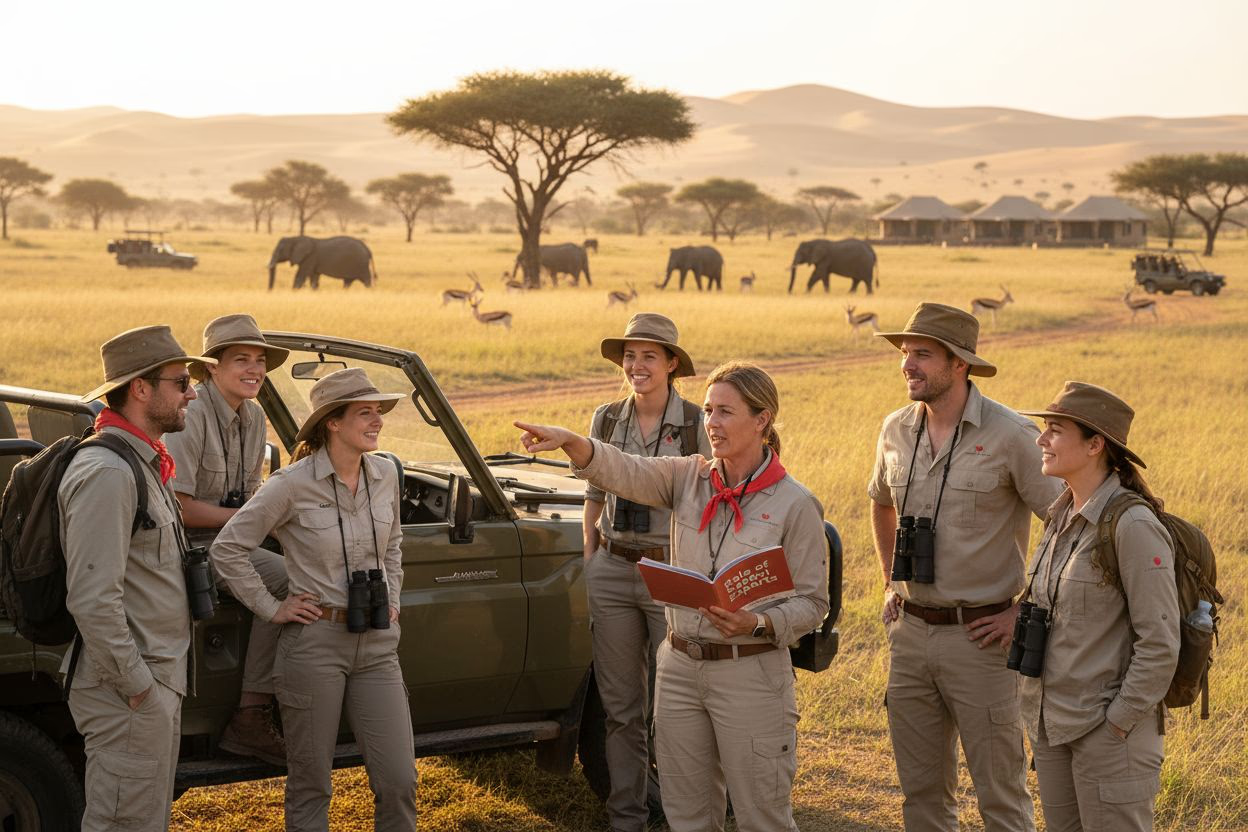
Optics: A guide in this tier will typically carry “The Big Three” (Swarovski, Leica, or Zeiss) binoculars, often in 8×42 or 10×42 configurations.
-
Reference Library: An iPad or a physical kit containing high-resolution plates for birds, mammals, and even celestial navigation.
-
The “Bush Newspaper” (CyberTracker): High-end guides use digital tracking software to log sightings, contributing to citizen science and conservation data.
-
Vehicle Customization: In the luxury tier, vehicles are modified with “swing-out” seats, sand-mats, and high-quality suspension to ensure the guest doesn’t feel the “corrugations” of the road.
-
Radio Comms: Use of private, encrypted frequencies to coordinate sightings without attracting “circuses” of 20+ vehicles.
Risk Taxonomy and Crisis Mitigation
Safety in the bush is a matter of “probability management.” A luxury safari guide operates on a taxonomy of risks that guests are often unaware of.
-
Category 1: Environmental Risks (Flash floods, lightning, heat exhaustion).
-
Category 2: Biotic Risks (Dangerous game encounters, insect-borne diseases).
-
Category 3: Mechanical/Technical Risks (Vehicle failure in lion territory, radio blackouts).
The primary failure mode in guiding is “complacency.” After 10 years in the bush, a guide might stop checking under the vehicle for lions or neglect to double-check the safety on a rifle. Luxury standards mandate a “Zero-Complacency” checklist performed every time a guest enters the vehicle.
Professional Governance and Long-Term Standards
The industry is governed by several national and international bodies that maintain the “Luxury safari guide” standard.
-
FGASA (Southern Africa): The gold standard for structured levels (Apprentice, Professional, Specialist).
-
KPSGA (Kenya): A similar bronze/silver/gold system.
-
BGT (Botswana): Highly regulated, focusing on the unique mokoro (dugout canoe) and delta navigation.
The Maintenance Cycle
A professional guide must undergo “re-certification” in first aid and rifle handling every 2–3 years. They are also expected to “cross-pollinate” by visiting different biomes to ensure their knowledge doesn’t become “property-blind.”
The Technical Metrics of Guiding Excellence
How do we measure a guide’s performance quantitatively and qualitatively?
-
Qualitative: Guest feedback on “narrative arc,” “empathy,” and “educational depth.”
-
Quantitative: Sighting success rates (within ethical limits), vehicle maintenance logs, and safety records.
-
Documentation Examples:
-
The Field Journal: A daily log of biodiversity observations.
-
The Incident Report: A transparent account of any safety breach or mechanical failure.
-
Common Misconceptions and Oversimplifications
-
Myth: The guide’s job is to find the “Big Five.”
-
Correction: The “Big Five” is a hunting term. A luxury guide focuses on the “Big Five Thousand,” including the vital role of dung beetles, fungi, and grasses.
-
Myth: A guide with a rifle is “safer.”
-
Correction: A guide who needs to use a rifle has likely made a series of tactical errors in reading animal behavior. The rifle is a sign of failure in communication between the guide and the animal.
-
Myth: Local guides are always better/worse than international guides.
-
Correction: Excellence is independent of nationality. A local guide has ancestral knowledge; an international guide may have broader comparative ecological knowledge. The “Luxury” standard is the synthesis of both.
Conclusion: The Future of Field Expertise
The luxury safari guide of the future will be part scientist, part diplomat, and part technologist. As wilderness areas shrink and become more fragmented, the role of the guide in “managing the interface” between human curiosity and animal survival will become the ultimate luxury. The true value of a guide is not their ability to find a lion, but their ability to ensure that when the lion is found, the encounter is respectful, educational, and contributes to the lion’s long-term survival. In the end, a great guide doesn’t just show you the world; they change the way you see it.