How to Avoid Safari Tipping Mistakes | 2026 Gratuity Guide
In the ecosystem of the African safari, the financial transaction is often masked by high-level hospitality, yet the “gratuity economy” remains the fundamental driver of service excellence and community support. For the luxury traveler, navigating this landscape requires more than just generosity; it requires a structural understanding of how lodges operate, the socio-economics of the host country, and the specific etiquette of wilderness encounters. In 2026, knowing how to avoid safari tipping mistakes has become a marker of the sophisticated explorer, moving beyond the simplistic “10% rule” of Western restaurants.
The complexity of tipping on safari arises from the decentralized nature of the service. On a single day, a traveler may interact with a private pilot, a transfer driver, a lodge porter, a housekeeping team, a gourmet chef, a specialized tracker, and a lead field guide. Each of these roles occupies a different niche in the lodge’s hierarchy and compensation structure. A mistake in tipping is rarely about the amount alone; it is frequently about the timing, the currency, the method of delivery, or the failure to account for “back-of-house” staff who remain invisible to the guest but are vital to the experience.
This pillar article serves as an analytical blueprint for the gratuity phase of a high-end expedition. We deconstruct the regional variations across East and Southern Africa, the psychological dynamics of the guide-guest relationship, and the logistical pitfalls of currency management in remote bush camps. By approaching tipping as a managed resource rather than an afterthought, the traveler ensures that their impact on the local economy is both positive and respectful.
Understanding “How to avoid safari tipping mistakes”
The primary misunderstanding of safari tipping is viewing it as a “bonus” for a lucky sighting rather than a “reward” for professional skill. A common error is tipping a guide excessively because they found a leopard, while tipping poorly because the animals were elusive despite the guide’s Herculean tracking efforts. To truly understand how to avoid safari tipping mistakes, one must decouple the “Wildlife Outcome” from the “Service Quality.”
Oversimplification also leads to the “Individual Bias” error. Travelers often tip the charismatic waiter who served their sundowner but forget the laundry team that meticulously pressed their technical gear or the maintenance crew that ensured the solar power and hot water functioned in a remote wilderness. The luxury safari industry has largely moved toward a “Bifurcated System”: direct tipping for the “front-of-house” specialists (guides/trackers) and a communal “Staff Tip Box” for the collective.
Finally, the most frequent logistical mistake is a failure of “Liquidity Planning.” Many high-end lodges are located in regions where credit card machines are temperamental, and ATMs are nonexistent. Arriving at the end of a ten-day trek with zero cash or only large-denomination bills (which cannot be split among staff) is a systemic failure of the trip’s governance. A successful strategy treats tipping as a line item in the initial budget, prepared weeks before departure.
Deep Contextual Background
The historical evolution of safari tipping is rooted in the “Professional Hunter” era, where tips were often large, lump-sum gifts of equipment or cash at the end of a long expedition. As the industry transitioned to photography-based tourism in the late 20th century, these practices became standardized. However, the 2020s have seen a “Digital Shift” and a “Currency Crisis” in many African nations.
In 2026, the reliance on the US Dollar (USD) remains constant, but the requirements for the physical notes have become increasingly rigid. Many East African banks will refuse any USD note printed before 2013 (Series 2009+) or any bill with even a microscopic tear. This “Physical Compliance” is a historical byproduct of past counterfeiting issues and local banking regulations. Consequently, a traveler with “old” money—even if it is perfectly legal in New York or London—is effectively carrying worthless paper in the Serengeti or the Okavango.
Conceptual Frameworks and Mental Models
To manage gratuities with precision, use these three mental models:
1. The “Bifurcated Flow” Model
Visualize the lodge staff as two distinct streams. Stream A consists of your “Constant Companions” (Guide and Tracker). They receive direct, personal envelopes. Stream B consists of the “Invisible Engine” (Kitchen, Housekeeping, Gardens, Maintenance). They are reached through the communal tip box. Never let Stream A overlap into the Tip Box, and never attempt to tip Stream B individually unless a specific staff member went remarkably above their duty.
2. The “Daily Accrual” Framework
Do not calculate tips on the fly at checkout. Instead, think in “Daily Units.” If the standard for a luxury guide is $20-$30 per person per day, mentally (or physically) set aside that amount every evening. This prevents the “Last-Day Shock” where the cumulative total for a family of four suddenly appears as a staggering $2,000 expense.
3. The “Purchasing Power” Parity
Avoid the mistake of over-tipping small tasks (like a 2-minute bag carry) while under-tipping high-skill tasks (like 6 hours of expert navigation). A $20 tip for a porter is often a month’s discretionary income in some regions, which can distort the local economy and create resentment among other staff. Conversely, a $5 tip for an 8-hour game drive is an insult to the guide’s years of training and biological expertise.
Key Categories and Tipping Matrices
Standards vary by region (Southern vs. East Africa) and by the level of luxury.
| Personnel Category | Recommended Tip (Per Guest/Day) | Preferred Method | Strategic Note |
| Field Guide / Ranger | $20 – $35 | Private Envelope | Hand directly at the final departure. |
| Tracker (if separate) | $10 – $15 | Private Envelope | Usually half the guide’s amount. |
| General Lodge Staff | $10 – $20 | Communal Tip Box | Divided among all back-of-house roles. |
| Private Butler | $15 – $20 | Personal Handover | Only in ultra-luxury “sole-use” villas. |
| Transfer Driver | $5 – $10 (per transfer) | Cash | Hand over at the airstrip/hotel arrival. |
| Specialist (Pilot/Doc) | $0 (Generally) | A Thank You | Most specialized professionals don’t expect tips. |
Decision Logic: The “Private Vehicle” Factor
If you have booked a private vehicle, the guide is working exclusively for you. In this scenario, the tipping range should shift toward the higher end ($30-$50 per vehicle per day) because the guide does not have other guests to “pool” tips from.
Detailed Real-World Scenarios
Scenario 1: The “Multi-Lodge” Itinerary
A traveler moves between three different lodges over 10 days.
-
The Mistake: Waiting until the very end of the 10 days to tip everyone.
-
The Correction: Tip at the end of each lodge stay. Once you fly to a new camp, you will likely never see the previous staff again, and the tip box is processed per guest departure.
Scenario 2: The “Inadequate Cash” Crisis
A guest realizes on the final morning that they only have $100 bills and need to tip three different people.
-
Failure Mode: Asking the lodge manager to “break” a $100 bill into five $20s. Lodges in the bush rarely have large cash reserves; they often rely on the guests to bring the small bills.
-
The Correction: Carry a “Gratuity Portfolio” consisting of $1s, $5s, and $10s specifically for this purpose.
Planning, Cost, and Resource Dynamics
The “Shadow Budget” of a safari is the gratuity. On a $15,000 trip, tips can easily account for an additional $1,000 to $1,500.
| Item | Requirement | Cost Allocation |
| USD Physical Quality | Series 2009+; Unmarked. | No extra cost, but high effort. |
| Denomination Mix | 40% in $10s; 40% in $5s; 20% in $1s. | Strategic withdrawal required. |
| Envelopes | 1 per lodge + 2 per guide/tracker. | Pack in travel documents. |
| Local Currency (ZAR/KES) | Small amounts for city markets. | Withdraw at the airport ATM. |
Tools, Strategies, and Support Systems
-
The “Pre-Packed Envelope” System: Before leaving home, label envelopes with “Guide,” “Staff Box,” and “Porter.” Stuff them with the baseline daily amount.
-
Digital Backups: While cash is king, apps like Venmo or WorldRemit are becoming common among younger, tech-savvy guides. However, never assume this is an option; always ask the lodge manager first.
-
The “Gratuity Calculator” Sheet: Keep a simple notebook or phone note tracking the days spent and the staff encountered to ensure no one is missed.
-
Lodge Manager Consultation: On the first day, ask: “What is your camp’s specific policy on tipping?” Some ultra-luxury lodges are “No Tipping” (e.g., some Singita properties), while others have very specific distribution rules.
-
Currency Conversion Apps: In Southern Africa (South Africa, Namibia), tipping in Rand (ZAR) is often preferred over USD. Use an app to ensure your ZAR tip matches the USD value you intended.
Risk Landscape and Failure Modes
1. The “Torn Bill” Rejection
The most common failure mode. A guide accepts a tip, only to find the bank will not take it because of a 2mm tear. This effectively negates the gift.
2. The “Public Performance” Error
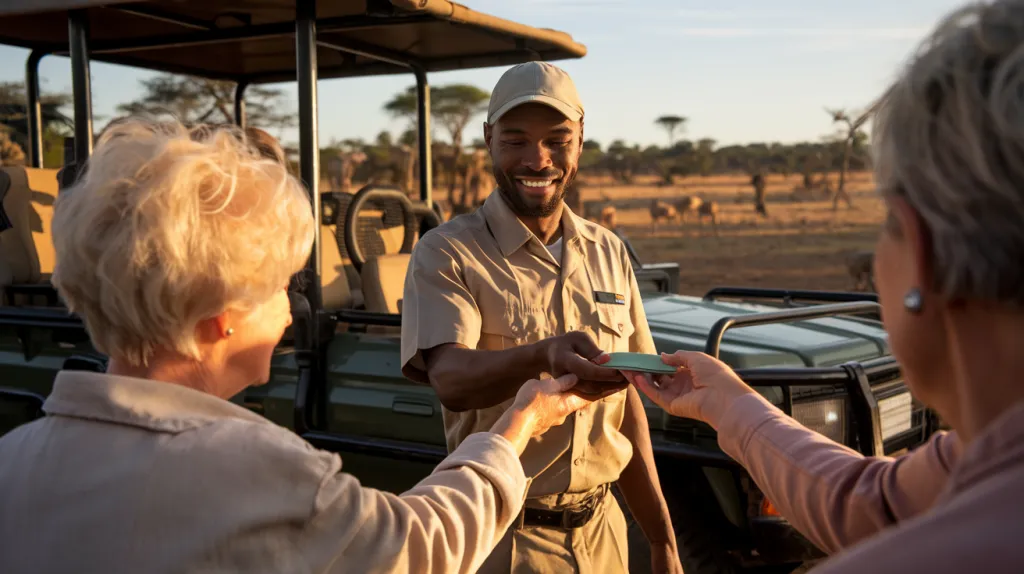
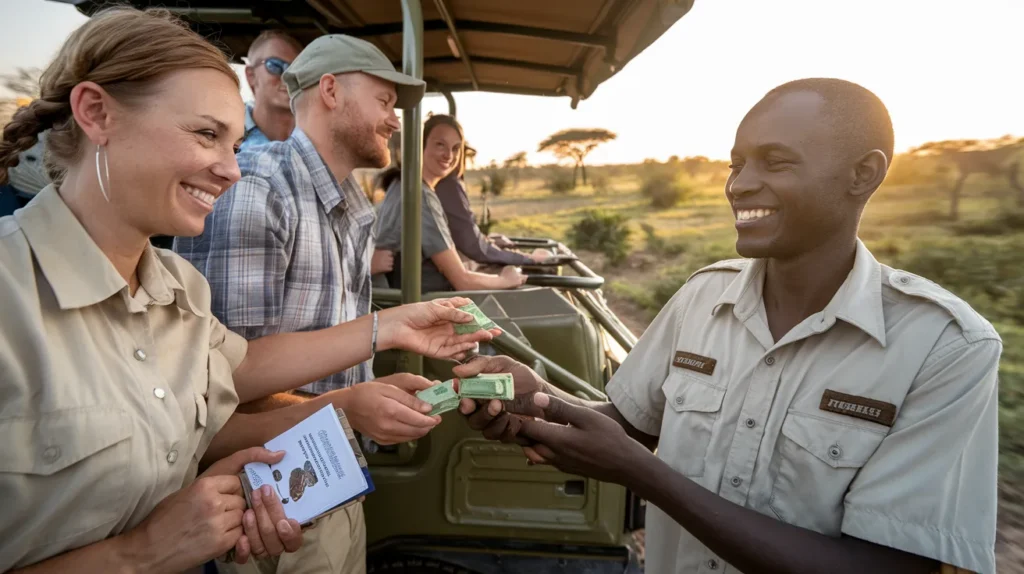
Handing a large wad of cash to a guide in front of other staff or guests. This can create social friction and security risks for the guide. Tipping should be a discreet “handshake” transfer or a private envelope handover.
3. The “Waitstaff Over-Tip.”
Tipping a waiter $20 after dinner. This often pulls money away from the communal box meant for the kitchen staff who actually cooked the meal, leading to internal lodge politics and demotivation of the “unseen” team.
Measurement, Tracking, and Evaluation
How do you know if your tipping was successful?
-
Leading Indicator: The “Ease of Departure.” If you are scrambling for cash at the airstrip, your system failed.
-
Qualitative Signal: The “Authentic Handshake.” A guide’s reaction to a thoughtful tip and a sincere “thank you” note is often more telling than the dollar amount.
-
The “Post-Safari Audit”: Did the gratuities stay within 5-10% of the total trip cost? If higher, you may be over-tipping; if lower, you might be under-contributing to the local ecosystem.
Common Misconceptions and Ethical Considerations
-
Myth: “The lodge pays them well; I don’t need to tip.”
-
Correction: While luxury lodges pay better than local averages, the “Safari Service Culture” is built on the gratuity model. Tips often fund education and housing for extended families.
-
Myth: “I should tip after every game drive.”
-
Correction: No. Tip at the end of the stay. Tipping daily creates an awkward “transactional” feeling for the rest of the trip.
-
Myth: “Giving clothes or gear is better than cash.”
-
Correction: No. While a guide might appreciate a pair of high-end binoculars or a technical jacket, cash is what pays for their children’s school fees. Only give gear as an addition to cash, never as a replacement.
Conclusion
To master how to avoid safari tipping mistakes is to respect the professional dignity of the men and women who make the wilderness accessible. A well-executed tipping strategy is the final act of a successful safari—a gesture that bridges the gap between the luxury of the guest and the reality of the host community. By planning denominations early, adhering to currency quality standards, and using the communal box for back-of-house staff, the traveler ensures their gratitude is both effective and appropriately distributed. In the end, the most valuable tip is the one that is given with the same level of care and preparation as the safari itself.